Final Fantasy Ii Famicom Battle Theme Download
| Final Fantasy II | |
|---|---|
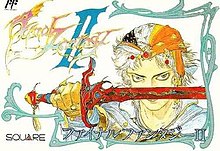 Cover fine art featuring main protagonist Firion | |
| Developer(s) | Square Co., Ltd. |
| Publisher(s) | Square Co, Ltd. |
| Director(due south) | Hironobu Sakaguchi |
| Producer(s) | Masafumi Miyamoto |
| Designer(s) |
|
| Programmer(south) | Nasir Gebelli |
| Artist(south) | Yoshitaka Amano |
| Author(due south) |
|
| Composer(s) | Nobuo Uematsu |
| Series | Final Fantasy |
| Platform(southward) | Family Computer
|
| Release | December 17, 1988[ii]
|
| Genre(s) | Role-playing |
| Way(south) | Single-player |
Last Fantasy Ii [a] is a fantasy part-playing video game adult and published by Square (at present Foursquare Enix) in 1988 for the Family Computer as the second installment of the Concluding Fantasy series. The game has received numerous enhanced remakes for the WonderSwan Color, the PlayStation, the Game Boy Advance, the PlayStation Portable, PC and multiple mobile and smartphone types. Equally neither this game nor Final Fantasy Three were initially released outside Nippon, Terminal Fantasy IV was originally released in North America as Final Fantasy Ii, so every bit non to confuse players. Following enhanced versions for iOS and Android in 2010 and 2012 respectively, the game was rereleased again every bit office of the 2021 Final Fantasy Pixel Remaster series.[4]
The game'due south story centers on four youths whose parents were killed during an regular army invasion past the empire of Palamecia, who are using hellspawn to conquer the world. Three of the four main characters join a rebellion confronting the empire, embarking on missions to gain new magic and weapons, destroy enemy superweapons, and rescue leading members of the resistance. The Game Boy Accelerate remake adds a bonus story after the game is completed.
Concluding Fantasy 2 introduced many elements that would later on become staples of the Concluding Fantasy franchise, including chocobos and the recurring character Cid. It also eliminated the traditional feel bespeak leveling system of the previous and later games in the serial, instead introducing an activity-based progression organisation where the characters' statistics increase according to how they are used or acquired. Despite beingness a sequel to Final Fantasy, the game includes no characters or locations from the get-go game. Last Fantasy Ii received little attention at the time from not-Japanese reviewers, though its remakes have garnered favorable reviews.
Gameplay [edit]
Final Fantasy Two features gameplay similar to that of its predecessor, Last Fantasy. The player can freely roam an overworld containing several towns and dungeons. A menu-based system allows the player to outfit each graphic symbol with equipment and up to two—often disposable—items for battle. Magic spells are assigned to the character from the item card, and certain spells, such as "Cure", can exist used exterior of battle.[5] The player can also save their progress on the overworld. Weapons, armor, items, and magic spells can exist purchased at shops, and townspeople provide useful data for the thespian's progression through the game. 1 new feature is the "Word Memory" system: when in conversation with non-player characters (NPCs), the player can "ask" about and "memorize" special keywords or phrases, which tin can after exist repeated to other NPCs to gain more information or unlock new actions. Similarly, in that location exist a handful of special items that tin be shown to NPCs during conversation or used on certain objects, which have the aforementioned event.[6] Characters and monsters are no longer separated into carve up windows in the battle screen as they were in the showtime Final Fantasy, and players tin run into their current and total hit points beneath the boxing. Players can also fight with less than iv characters in their party, which was not possible in the first game. Terminal Fantasy Ii introduced the chocobo, the signature Final Fantasy mascot, which lets characters ride to a location at corking speed without being attacked by enemies. The recurring character Cid was also introduced, and a character of the same name has appeared in every main-series game since.[7]
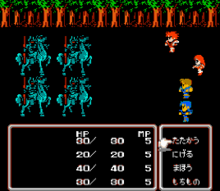
The ill-blighted opening battle in the Famicom version
On the overworld and within dungeons, random encounters with enemies can be fought to improve each graphic symbol'south attributes.[8] Dissimilar the original Last Fantasy, players cannot upgrade their characters' classes. The game is also ane of the few games in the series to not apply feel-based levels. Instead, each character participating in battle develops depending on what deportment they accept. For instance, characters who frequently utilise a particular blazon of weapon will become more skilful at wielding a weapon of that type, and will likewise increase in physical strength and accuracy.[7] [viii] Attributes include hitting points, magic points, magic power, stamina, force, spirit, agility, intelligence, and evasion. Striking points (HP) and magic points (MP) increase with their employ; a character who takes a heavy amount of damage in a boxing might earn an increase in maximum HP, while a character who uses a lot of MP during battle might increment their maximum MP.[eight] This experience system had several unintended consequences that immune characters to proceeds much more experience than intended, such as players having their characters assail each other and repeatedly bandage spells, thus causing their HP and abilities to grow extensively.[7] Last Fantasy II uses the same turn-based battle system seen in the original Concluding Fantasy, with battle parties consisting of upward to four characters at a time. The game introduces a "back row" in battle, inside which characters or enemies are allowed to most physical attacks, but can be harmed with bows and magical attacks.[5]
Plot [edit]
Characters [edit]

Yoshitaka Amano's artwork of the principal characters Leon, Firion, Maria, and Guy
Final Fantasy 2 features four playable characters as well equally several secondary characters who are simply briefly controlled by the player. Primary characters include Firion ( フリオニール , Furionīru , "Frioniel" in the Japanese release and English NES paradigm), a resident of the country of Fynn and the chief protagonist; Maria ( マリア ), a soft-spoken archer and defended enemy of the Empire; Guy ( ガイ , Gai , "Gus" in the remake for the PlayStation), a uncomplicated monk who communicates with animals; and Leon ( レオンハルト , Reonharuto , "Leonhart" in the Japanese release and English NES prototype), a conflicted night knight who is missing for most of the game.[vii] [9] Five playable characters temporarily join the political party to assist Firion, Maria, and Guy in their missions for the rebellion. These are Gordon ( ゴードン , Gōdon ), the prince of Kas'ion and a member of the rebellion; Josef ( ヨーゼフ , Yōzefu ), a villager in the boondocks of Salamand; Leila ( レイラ , Reira , "Reila" in the Japanese release and English NES prototype), a pirate; Minwu ( ミンウ , Min'u , "Mindu" in the PlayStation remake and "Ming-Wu" in the Japanese release and English language NES prototype), who is a White Mage with the rebellion, and Ricard Highwind ( リチャード・ハイウインド , Richādo Haiuindo , "Gareth" in the PlayStation remake, Edward in the English language NES prototype and "Richard" in the Japanese release), who is the first dragoon to announced in the series.[7]
Firion and the Emperor of Palamecia ( パラメキア皇帝 , Paramekia Kōtei ) (named Mateus ( マティウス , Matiusu ) in Kenji Terada's novelization of the game) are the respective hero and villain representing Final Fantasy 2 in Dissidia Concluding Fantasy, Dissidia 012 Final Fantasy and Dissidia Last Fantasy NT, fighting games featuring characters from across the series. Firion is voiced by Hikaru Midorikawa in the Japanese versions and by Johnny Yong Bosch in the English versions; Mateus is voiced by Kenyu Horiuchi in the Japanese versions and Christopher Corey Smith in the English versions. In the PlayStation's opening FMV of Terminal Fantasy Ii, Firion is besides voiced by Yukimasa Obi, while Maria is played past Noriko Shitaya, Guy by Kenta Miyake, and Leon past Takayuki Yamaguchi.
Story [edit]
Last Fantasy Two begins every bit Firion, Maria, Guy and Leon are attacked past Palamecian Black Knight soldiers and left for dead. Firion, Maria, and Guy are rescued by Princess Hilda, who has established a insubordinate base in the town of Altair after her kingdom of Fynn was invaded past the Emperor. Hilda denies their request to bring together the rebel army considering they are besides young and inexperienced. The 3 set off for Fynn in search of Leon; there they find a dying Prince Scott of Kas'ion, Hilda'southward fiancé, who informs them that a former nobleman of Kas'ion, Borghen, betrayed the rebellion and became a General in the Imperial regular army. The party returns to Altair to inform Hilda. She allows the group to bring together the rebellion and asks them to journeying north to find mythril, a metal which could be used to create powerful weapons. The political party makes its manner north to the occupied village of Salamand, saves the villagers forced to work in the nearby mines, kills Borghen, and retrieves the mythril.
For their next mission, the party is sent to the city of Bafsk to prevent the construction of a big airship known as the Dreadnought; withal, it takes off but as they get in. After retrieving the Sunfire, a weapon which can blow upwards the Dreadnought, they scout helplessly as an balloon with Hilda on board is captured by the Dreadnought. When the Dreadnought lands to stock upwards on supplies, the political party rescues Hilda and throws the Sunfire into the airship's engine. Before escaping from the explosion, the political party encounters a nighttime knight whom Maria thinks she recognizes as Leon.
On his deathbed, the Rex of Fynn tasks the party to seek the aid of the seemingly extinct dragoons of Deist. In Deist, the political party finds only a mother with her son, learning that all but i of the Dragoons are dead, partly as a result of Purple poison. After placing an egg of the last wyvern in a cavern, the party returns to Altair and rescues Hilda from the Empire a 2d time, before successfully reclaiming Fynn from the Imperial forces. They so travel west in search of a powerful magic item, joining forces with the final surviving dragoon on the way. The party returns to Fynn and sees that many towns have been destroyed past a cyclone summoned by the Emperor. The political party calls upon the newly born last wyvern to take them to a castle inside the whirlwind, where they confront and kill the Emperor. Back at Fynn, everyone celebrates the Empire's defeat, only a mortally wounded Fynn soldier arrives and reveals that Leon has taken the throne and plans to destroy the Rebels with the Imperial regular army.
The party enters the castle of Palamecia and confronts Leon. All the same, the Emperor reappears in the throne room in a new demonic course, revealing he has returned from Hell with the intention of destroying the entire world. The political party and Leon escape Palamecia Castle with the wyvern, every bit the castle is replaced with the palace of Hell, Pandaemonium. Leon agrees to help the grouping seal the Emperor away. The party travels to the Jade Passage, an underground passage to the underworld, and finds the portal to Pandaemonium, where they finally defeat the Emperor. Afterwards, Leon chooses to go out in response to the problem he caused, though Firion assures him that he'll exist welcomed dorsum if and when he returns.
Soul of Rebirth [edit]
The Dawn of Souls remake of the game for the Game Boy Advance includes an additional storyline that takes place after the game, which follows the four party members who died during the story of the game.
Post-obit his sacrifice to unseal the door guarding the Ultima Tome, Minwu awakens in a new area and sees someone resembling Gordon fight off Majestic soldiers. Minwu assists him, and the man soon explains he is Scott, Gordon'south blood brother. Minwu informs him of the events up to his ain demise, and the two surmise they are in the Jade Passage since both died. They detect Josef and subsequently Ricard, eventually emerging in Machanon, a village in the mirror image of Poft where the citizens are dead victims of the Emperor'due south conquest, including Cid and Tobul, with the former asking the group to discover out where they are and why they have been called hither.
The four enter the teleporter at the north edge of town and enter what Minwu believes is Pandaemonium. Climbing to the highest floor, the party meets the Low-cal Emperor, who explains that when Firion and his allies killed him, his soul was split, with the Emperor'southward "dark half" falling to Hell and acquiring more ability, while his low-cal half—the Emperor they now see—ascended to Sky. He then explains they are in Arubboth, palace of Heaven, and the cavern they traveled through was Raqia, the identify where fallen angels are cast downwards to become demons, and that he called them here to ask for forgiveness on the behalf of his dark half, and offers them eternal life with him in Arubboth if they forgive his sins.
Though the four are tempted past the offer, apparitions of their loved ones show them a vision of Firion and his allies battling the Dark Emperor in Pandaemonium. Realizing this Emperor is just as evil every bit the original, the four decline his offer, and defeats the Light Emperor merely equally Firion and his allies vanquish the Dark Emperor. As the rebels in the world of the living celebrate their victory, the specters of Minwu, Scott, Josef and Ricard lookout man them and wish them well, and as they fade away into peaceful rest, Minwu comments that if anyone can change man'southward legacy of violence, it's Firion and his friends.
Evolution [edit]
During the development of the first installment in the series, Square's management decided to manufacture 400,000 copies of the game to make a sequel possible,[x] then the original Famicom (NES) version successfully shipped 520,000 copies in Japan.[eleven] As in that location were no concrete ideas for Terminal Fantasy II from the get-go, it was somewhen taken in a new direction and included none of the previous game's characters or locations.[7] [10] Hironobu Sakaguchi, who had previously served as the main planner for Final Fantasy, causeless the office of director to arrange for the larger development team.[3] Using the feel gained from the get-go installment, which focused more than on plumbing fixtures story ideas into their new gameplay organization and game world, the developers fully crafted the story of Final Fantasy II first. The gameplay was then built effectually the narrative.[12] The experience system was designed to be a more realistic advancement system than that of the first game. Several members of the original staff from the first game reprised their jobs for Terminal Fantasy Ii. Sakaguchi again created the plot for the championship, with the actual scenario written past Kenji Terada.[3] [13] Nobuo Uematsu composed the music, every bit he had for the first game, while Yoshitaka Amano was once more the concept artist.[7] Equally with the original, Last Fantasy II was programmed by Nasir Gebelli.[fourteen] Midway through the evolution of the game, Gebelli was forced to return to Sacramento, California from Japan due to an expired work visa. The residual of the development staff followed him to Sacramento with necessary materials and equipment and finished production of the game there.[15] The game was released ane day less than a twelvemonth afterward the commencement game came out.[7]
In April 1989, the game was novelized by its original scenario writer Kenji Terada under the title Final Fantasy II: Muma no Meikyū (lit. "The Labyrinth of Nightmares"). It was published in Nippon exclusively by Kadokawa Shoten.[16]
Music [edit]
The music for Final Fantasy Ii was afterwards bundled by Tsuyoshi Sekito for the WonderSwan Color, PlayStation, and Game Boy Advance remakes. Although the two soundtracks were composed separately, the soundtrack to Ii has only been released as a combined album with the soundtrack to Final Fantasy I. They were beginning released as All Sounds of Concluding Fantasy I•2 in 1989, which was and then republished in 1994.[17] An arranged anthology of music from the two soundtracks titled Symphonic Suite Final Fantasy was also released in 1989, while Final Fantasy & Terminal Fantasy II Original Soundtrack, a combined soundtrack album for the PlayStation versions of the games, was released in 2002 and re-released in 2004.[18] [nineteen] The music of Final Fantasy Ii has also appeared in various official concerts and live albums, such as 20020220 music from Concluding Fantasy, a live recording of an orchestra performing music from the series including several pieces from the games.[xx] Additionally, several songs from the game were performed every bit role of a medley past the Royal Stockholm Philharmonic Orchestra for the Distant Worlds – Music from Concluding Fantasy concert tour,[21] while a unlike medley of songs from the game were performed by the New Nippon Philharmonic Orchestra in the Tour de Japon: Music from Final Fantasy concert series.[22]
Versions and re-releases [edit]
Final Fantasy II has been remade several times for different platforms, and has frequently been packaged with the first Final Fantasy in various collections. While all of these remakes retain the aforementioned basic story and battle mechanics, diverse tweaks accept been made in different areas, including graphics, sound, and specific game elements.
| Championship | Release | Country | System | Developer | Publisher | Notes |
|---|---|---|---|---|---|---|
| Final Fantasy II | 1988 | Japan | Family Computer | Foursquare | Foursquare | The original version |
| Terminal Fantasy I・II | 1994 | Nippon | Family Estimator | Foursquare | Square | A few graphical updates |
| Final Fantasy 2 | 2001 | Japan | WonderSwan Color | Foursquare | Square | Background images in boxing scenes, re-fatigued sprites |
| Terminal Fantasy Origins | 2002 2003 2003 | Nippon USA EUR | PlayStation | Tose | Squaresoft | All-new, more than detailed graphics, remixed soundtrack, FMV sequences, art galleries, memo save function |
| Final Fantasy I & II: Dawn of Souls | 2004 | Nippon USA EUR | Game Boy Advance | Tose | Nintendo | 4 additional dungeons, updated bestiary, a few tweaks |
| Final Fantasy Ii | 2005 | Japan | Mobile phone | Square Enix Namco Bandai Games | Superior to the 8-flake original but less avant-garde than recent ports | |
| Terminal Fantasy Ii | 2007 2007 2008 | Japan USA EUR | PlayStation Portable | Tose | Square Enix | Higher-resolution 2D graphics, FMV sequences, remixed soundtrack, bonus dungeons and script from Dawn of Souls |
| Terminal Fantasy II | 2009 | Japan | Wii Virtual Console | Square Enix | Virtual Console release of the original Famicom version | |
| Final Fantasy 2 | 2009 2012 | Japan Us | PlayStation Store PSOne Classics | Square Co. | PlayStation version was released as PSOne Classics | |
| Final Fantasy II | 2010 | worldwide | iOS | Square Enix | Square Enix | Based on the PSP version |
| Final Fantasy 2 | 2011 | Japan EUR | PlayStation Shop downloadable PSP games | Square Enix | PlayStation Portable version was released equally downloadable PSP game | |
| Final Fantasy II | 2012 | worldwide | Android | Matrix Software | Square Enix | Based on the iOS version |
| Terminal Fantasy Ii | 2012 | Japan | Nintendo 3DS Virtual Console | Square Enix | Virtual Console release of the original Famicom version | |
| Concluding Fantasy II | 2013 | Japan | Wii U Virtual Console | Foursquare Enix | Virtual Console release of the original Famicom version | |
| Last Fantasy I & Ii Advance | 2016 | Japan | Wii U Virtual Console | Square | Square Enix | Virtual Console release of the GBA version |
| Concluding Fantasy Ii | 2021 | worldwide | Microsoft Windows Steam Android iOS | Foursquare Enix | Foursquare Enix | 2D remaster based on the original game |
Unreleased English version [edit]
Following the successful North American release of the original Last Fantasy by Nintendo in 1990, Square Soft, Square's Due north American subsidiary, began work on an English language localization of Final Fantasy Two, to be called Final Fantasy Ii: Dark Shadow Over Palakia. Assigned to the projection was Kaoru Moriyama, whose later work included script translations for Final Fantasy IV and Hole-and-corner of Mana (known as Seiken Densetsu ii in Japan). Although a beta version was produced, and the game was advertised in several Square Soft trade publications, the long evolution fourth dimension, the historic period of the original Japanese game and the arrival of the Super Nintendo Amusement System, the NES's successor panel, led Square Soft to cancel work on the Concluding Fantasy II localization in favor of the recently released Terminal Fantasy 4 (which, to avoid disruptive North American players, was retitled Final Fantasy II).[vii] [23]
Although a prototype cartridge of the English NES Concluding Fantasy 2 was produced, the projection was, by Moriyama'south own access, still far from complete; "We had so very limited retention capacity we could use for each game, and information technology was never really "translating" just chopping up the data and cramming them back in... [Additionally] our boss had no understanding in putting in extra work for the English version at that time."[23] In 2003, when the game was finally released to English-speaking audiences every bit part of Final Fantasy Origins, it was released with new graphics, music, and a brand new translation nether the supervision of Akira Kashiwagi. A fan translation of the original game was also created prior to the release of Origins, and makes utilise of an original translation equally the being of the prototype cartridge was not common cognition at the time.[23]
Re-releases [edit]
In addition to its original Famicom release, Final Fantasy II was re-released on the WonderSwan Color in 2001, and both singularly and equally part of a collection with Final Fantasy I for the PlayStation in 2002. It was released on the Game Boy Accelerate in 2004 as part of Terminal Fantasy I & II: Dawn of Souls, on the PlayStation Portable in 2007, and for the Japanese Wii Virtual Panel on June 16, 2009.[24]
The Concluding Fantasy I•2 drove included the original game with but minor changes. The WonderSwan Color remake of the game was starting time released on May three, 2001, and afterwards included every bit a package with a special Final Fantasy Ii edition of the console.[25] It included completely redone graphics in the manner of the xvi-chip generation Final Fantasy games and includes larger graphic symbol sprites, remixed music by Tsuyoshi Sekito, and full graphical backgrounds in battle mode.[26] The PlayStation version featured fifty-fifty more than graphical updates over the WonderSwan version, and the soundtrack was again remixed by Tsuyoshi Sekito to a higher quality so as to use the audio capabilities of the PlayStation. Sekito as well composed a few new tracks to be used in the new cutscenes. It was published both individually (in Nihon only) and alongside Final Fantasy I in a drove entitled Final Fantasy Origins (or Final Fantasy I+II Premium Collection in Nihon); this was the first release of the game outside Japan.[27] On December 18, 2012 the port was re-released equally part of the Terminal Fantasy 25th Anniversary Ultimate Box parcel.[28]

A typical battle scene from the Final Fantasy I & II: Dawn of Souls remake
Final Fantasy 2 was over again released in a new format in 2004 for the Game Boy Advance every bit part of Last Fantasy I & II: Dawn of Souls. The main alter for this version was the addition of a bonus storyline entitled Soul of Rebirth attainable to the player afterwards completing the game.[29] In 2004 and 2006, Square Enix released a version of Final Fantasy Two for three Japanese mobile phone networks.[thirty] To gloat the Final Fantasy series' 20th anniversary, the game was released in Nihon for the PlayStation Portable in 2007.[31] The remake features improved graphics, the cutscenes and soundtrack from Concluding Fantasy Origins, and the bonus quest and dungeons from Final Fantasy I & Two: Dawn of Souls. Information technology additionally includes 4 new dungeons in which more character-specific equipment can exist establish, alongside powerful enemies and two new bosses.[32] The release for the Japanese Virtual Panel for the Wii on June 16, 2009, for the Wii U on December eleven, 2013, and for the Nintendo 3DS on February 12, 2014, is identical to the original Famicom release, incorporating none of the updates of the subsequently versions.[24] On Feb 25, 2010, Square Enix released a port of the PSP version modified with touchscreen controls for the iOS platform.[33] Post-obit this, a touchscreen port was brought to Android in 2012 through the Google Play shop.[34]
Reception [edit]
According to Square's publicity department, the original Famicom release sold 800,000 copies.[49] Every bit of March 31, 2003, the game, including all re-releases at the time, had shipped ane.28 million copies worldwide, with 1.08 million of those copies beingness shipped in Japan and 200,000 abroad.[50] Despite having merely been released in June of that year, as of September 2007 the PlayStation Portable version had shipped 90,000 copies in Nihon and 70,000 in N America.[51] Despite these high sales, the game had sold the fewest copies of whatever of the outset ten main games in the Terminal Fantasy series.[50]
Upon release, Famicom Tsūshin (now Famitsu) gave the original Famicom version a score of 35 out of 40, based on a panel of 4 reviewers giving information technology ratings of 9, 9, 9 and 8 out of x. This made information technology one of their 3 highest-rated games of 1988, along with Dragon Quest Iii (which scored 38/forty) and Super Mario Bros. iii (which scored 35/40). Information technology was likewise ane of the mag'southward five highest-rated games up until 1988, along with Dragon Quest Two (which scored 38/40) and Zelda II: The Adventure of Link (which scored 36/forty).[39] The 1989 "All Soft Catalog" issue of Famicom Tsūshin included Final Fantasy II in its list of the best games of all fourth dimension, giving it the All-time Scenario award.[48] Retrospectively, G4 described the stat-building organisation as an "Innovation", noting that "Computer RPGs took the "level" system wholesale from tabletop office-playing games and fabricated information technology a genre staple, but FF2 eliminated levels altogether," but that what "sounds novel at outset wound upwardly being a huge mess".[52]
The game's re-releases accept been more heavily reviewed. Famitsu mag scored the WonderSwan version of the game a 30 out of 40,[forty] and GameSpot noted the Dawn of Souls ' by and large outdated graphics but praised its length and bonus content.[53] IGN noted the cracking improvement in the translation of the story over Final Fantasy I and the addition of afterward Final Fantasy features, such as being able to salve anywhere in the overworld map without a tent or cabin.[54] The Dawn of Souls release was named the IGN Game Male child "Game of the Month" for March 2004, and the package was rated 76th in Nintendo Ability 's Top 200 Games list.[55] [56] The dialogue system was thought to be time consuming and stilted, just was still a milestone for interactivity. The story was considered to exist much more involved and deep than the first Final Fantasy, every bit information technology involved romance and the death of characters. The game'south plot was thought by some reviewers to mirror elements of Star Wars: A New Hope in its employ of an orphan joining a rebellion confronting an empire that was edifice a massive transport, with a convict princess inside.[7] GameSpy praised the addition of the ability to save the game at any time, calling the characteristic crucial for a game on a handheld game console, and in contrast to GameSpot, praised the graphics, proverb that while they were primitive, they were "well-suited" to the Game Boy Advance.[57] Game Informer placed the game 40th on their peak 100 video games of all fourth dimension in 2001 praising the original story.[58]
The PSP version was met with generally average reviews. GameSpot described the "more intriguing" story and "key words" organisation as "notable" in "the evolution of the series and genre" merely called the level upwardly system "chaotic" and noted that unlike previous versions, this was shipped without a version of Terminal Fantasy I.[42] IGN described the "dialogue and story" equally "much more interesting than" its predecessor and the "proficiency organisation not unlike what's constitute in The Elderberry Scrolls" equally a "semi-innovation" for its fourth dimension, but also complained about the gameplay, saying, "If you're the type of player who puts a higher emphasis on more than satisfying gameplay experiences [...] and so FF2 definitely isn't the upgrade information technology appears to exist."[44] Both sources praised the graphics, however.[42] [44] GameSpy, however, while echoing similar complaints about the "quirky and sometimes confusing" leveling system and praises for the graphics, also applauded the supposed decrease in difficulty of the game, which in the reviewers' opinion eliminated the necessity to corruption the leveling system in society to progress in the game as the player had to do in the original game.[43]
See as well [edit]
- Listing of Square Enix video game franchises
Notes [edit]
- ^ Terminal Fantasy II ( ファイナルファンタジーII , Fainaru Fantajī Tsū )
References [edit]
- ^ Diaz, Ana (June 30, 2021). "Final Fantasy Pixel Remaster'south first 3 games come up to PC and mobile in July". Polygon. Retrieved June xxx, 2021.
- ^ "Terminal Fantasy 7: In the Beginning...". Electronic Gaming Monthly. No. 93. Ziff Davis. Apr 1997. p. 72.
- ^ a b c "Interview with Hironobu Sakaguchi". Shūkan Famitsu. ASCII. June 5, 1998. Archived from the original on July 17, 2011. Retrieved Feb 6, 2011.
- ^ "Final FANTASY PIXEL REMASTER". Final FANTASY Pixel Remaster . Retrieved August 27, 2021.
- ^ a b Final Fantasy Origins instruction transmission. Square Enix. 2003. p. 17. SLUS-05141.
- ^ Final Fantasy Origins pedagogy manual. Square Enix. 2003. pp. xv, 22. SLUS-05141.
- ^ a b c d e f g h i j "Final Fantasy Retrospective: Part Two". GameTrailers. July 23, 2007. Archived from the original on July 4, 2015. Retrieved August 30, 2012.
- ^ a b c Concluding Fantasy Origins instruction transmission. Foursquare Enix. 2003. p. 22. SLUS-05141.
- ^ Concluding Fantasy Origins instruction manual. Square Enix. 2003. p. 15. SLUS-05141.
- ^ a b Fearfulness, Ed (December 13, 2007). "Sakaguchi discusses the development of Terminal Fantasy". Develop. Intent Media. Archived from the original on September 22, 2013. Retrieved Oct 16, 2008.
- ^ "もっとも売れたのはどれ? 歴代「Ff」シリーズの出荷本数をまとめてみました".
- ^ Kent, Steven (2001). "The Mainstream and All Its Perils". Ultimate History of Video Games. Three Rivers Press. pp. 541–542. ISBN0-7615-3643-4.
- ^ Square (Dec 17, 1988). Final Fantasy Two (Family unit Calculator). Square Co., Ltd. Scene: staff credits.
- ^ Lau, John (January 22, 2005). "The Hush-hush of Nasir". Academy of Hawaii. Archived from the original on July sixteen, 2007. Retrieved July 14, 2008.
- ^ Mielke, James; Hironobu Sakaguchi. "A Day In The Life Of Hironobu Sakaguchi". EGM (232).
[...] And so for Final Fantasy II and III, our staff actually brought all the equipment, everything that was necessary to finish those games, to Sacramento, because (Gebelli) couldn't come back to Nihon. [...] We finished Final Fantasy Ii and Three in Sacramento, California. [Laughs]
- ^ "ファイナルファンタジー2 夢魔の迷宮". Yahoo! Nihon: Books. Archived from the original on July 25, 2011. Retrieved January 12, 2010.
- ^ Gann, Patrick; Schweitzer, Ben. "All Sounds of Final Fantasy I – 2". RPGFan. Archived from the original on January sixteen, 2013. Retrieved July 9, 2008.
- ^ Gann, Patrick. "Final Fantasy Symphonic Suite". RPGFan. Archived from the original on Jan 16, 2013. Retrieved July 9, 2008.
- ^ "Final Fantasy I • II Original Soundtrack". RPGFan. Archived from the original on January 16, 2013. Retrieved September 14, 2008.
- ^ "20020220 – Music from Terminal FANTASY". RPGFan. Archived from the original on January 20, 2013. Retrieved April 1, 2007.
- ^ "Distant Worlds – Music from Final Fantasy – Anthology Information". Square Enix Music Online. Archived from the original on April 9, 2012. Retrieved February 22, 2008.
- ^ "Anthology Information – Tour de Japon: Music from Final Fantasy DVD". Foursquare Enix Music Online. Archived from the original on January xx, 2013. Retrieved February 22, 2008.
- ^ a b c Collette, Chris. "Spotlight: Final Fantasy II". LostLevels.org. Archived from the original on September 2, 2006. Retrieved August 25, 2006.
- ^ a b "VC ファイナルファンタジーII" (in Japanese). Nintendo. Archived from the original on Feb 25, 2010. Retrieved Nov 30, 2009.
- ^ Wonderswan Gamer (Jan 19, 2006). "Final Fantasy II Boxset". Wonderswan Gaming. Archived from the original on January 6, 2007. Retrieved September 4, 2006.
- ^ fastbill1. "Concluding Fantasy Ii". PortableReview.com. Archived from the original on Dec 25, 2007. Retrieved September iv, 2006.
- ^ Triche, Stephen (2002). "Terminal Fantasy Origins". gamevortex.com. Archived from the original on Nov 2, 2010. Retrieved March 8, 2006.
- ^ Gantayat, Anoop (August 31, 2012). "Total Terminal Fantasy 25th Anniversary Ultimate Box Game Listing". Andriasang. Archived from the original on September 21, 2013. Retrieved September 2, 2012.
- ^ Gantayat, Anoop (July 2, 2004). "Last Fantasy Pushed Back". IGN. Archived from the original on October 9, 2013. Retrieved September 3, 2006.
- ^ "Final Fantasy mobile". Square Enix. Archived from the original on October 20, 2012. Retrieved March twenty, 2007.
- ^ "Final Fantasy for PSP". Famitsu. Archived from the original on April ane, 2007. Retrieved March xx, 2007.
- ^ "Square-Enix to remake FF I and Ii for ceremony". IGN. Archived from the original on October 9, 2013. Retrieved January 18, 2007.
- ^ Lanxon, Nate (February 25, 2010). "Final Fantasy now available on iPhone". Wired. Archived from the original on Feb 27, 2010. Retrieved Feb 25, 2010.
- ^ Foursquare ENIX Co.,Ltd. "FINAL FANTASY 2 – Android Apps on Google Play". google.com. Archived from the original on Nov five, 2013.
- ^ "Terminal Fantasy Ii for PSP". GameRankings. CBS Interactive. Archived from the original on October thirty, 2016. Retrieved June 9, 2018.
- ^ "Final Fantasy II for PSP Reviews". Metacritic. Red Ventures. Archived from the original on October 29, 2017. Retrieved June 9, 2018.
- ^ "Concluding Fantasy Two for iPhone/iPad Reviews". Metacritic. Red Ventures. Archived from the original on Nov 18, 2015. Retrieved January 12, 2015.
- ^ "Final Fantasy II Pixel Remaster for PC Reviews". Metacritic. Red Ventures. Retrieved Nov xviii, 2021.
- ^ a b "Famitsu Hall of Fame". Geimin. Archived from the original on February 4, 2010. Retrieved February 7, 2012.
- ^ a b ワンダースワン – ファイナルファンタジーII. Weekly Famitsu. No.915 Pt.two. Pg.112. June 30, 2006.
- ^ "ファイナルファンタジーII (PS)". Famitsu. Archived from the original on September 24, 2015. Retrieved January 12, 2015.
- ^ a b c VanOrd, Kevin (August 3, 2007). "Final Fantasy II Review". GameSpot. Archived from the original on November 5, 2012. Retrieved November 25, 2009.
- ^ a b Graziani, Gabe (July 26, 2007). "Final Fantasy II". GameSpy. Archived from the original on July 16, 2008. Retrieved December 2, 2009.
- ^ a b c Dunham, Jeremy (July 26, 2007). "Final Fantasy II Review". IGN. Archived from the original on December 10, 2012. Retrieved November 25, 2009.
- ^ Levi Buchanan (February 25, 2010). "Final Fantasy Ii Review: The one where Cid shows up". IGN. Archived from the original on January 12, 2015. Retrieved January 12, 2015.
- ^ Hodapp, Eli (Feb 24, 2010). "'Last Fantasy' and 'Final Fantasy II' – Excellent Ports of RPG Classics". TouchArcade . Retrieved June 9, 2018.
- ^ Musgrave, Shaun (July 30, 2021). "'Last Fantasy 2' Pixel Remaster Review – The Emperor Strikes Back". TouchArcade . Retrieved July 30, 2021.
- ^ a b "Best Scenario Honour: Final Fantasy 2", Famicom Tsūshin, no. All Soft Itemize '89, 1989
- ^ "Final Fantasy III". Electronic Gaming Monthly. Ziff Davis (63): 172. October 1994.
- ^ a b "Titles of game software with worldwide shipments exceeding ane one thousand thousand copies" (PDF). Square Enix. Feb 9, 2004. p. 27. Archived (PDF) from the original on Nov ix, 2013. Retrieved March 1, 2008.
- ^ "FY2007 Start-One-half Flow Results Conference Session" (PDF). Square-Enix.com. November 19, 2007. Archived (PDF) from the original on September 22, 2013. Retrieved January thirteen, 2009.
- ^ G4 Staff (March 16, 2012). "The Innovation of Concluding Fantasy – Hits and Misses". G4. Archived from the original on Jan 12, 2015. Retrieved January 12, 2015.
- ^ Massimilla, Bethany (November 29, 2004). "Final Fantasy 1 & 2:Dawn of Souls". GameSpot. Archived from the original on October 26, 2012. Retrieved August 31, 2006.
- ^ Dunham, Jeremy (November thirty, 2004). "Concluding Fantasy I & Ii: Dawn of Souls". IGN. Archived from the original on September 17, 2012. Retrieved August 31, 2006.
- ^ IGN Staff (November xxx, 2004). "GBA Game of the Month: November 2004". IGN. Archived from the original on October 9, 2013. Retrieved September 3, 2006.
- ^ Michaud, Pete (January 2006). "NP Acme 200". Nintendo Ability. 199: 42–43.
- ^ Vassar, Darryl (Dec 1, 2004). "Terminal Fantasy I & II: Dawn of Souls". GameSpy. Archived from the original on October 4, 2013. Retrieved Dec ii, 2009.
- ^ Cork, Jeff. "Game Informer's Top 100 Games Of All Time (Circa Issue 100)". Game Informer . Retrieved December 1, 2020.
External links [edit]
-
 Quotations related to Final Fantasy Two at Wikiquote
DOWNLOAD HERE
Posted by: allenlizes1945.blogspot.com


0 Komentar
Post a Comment